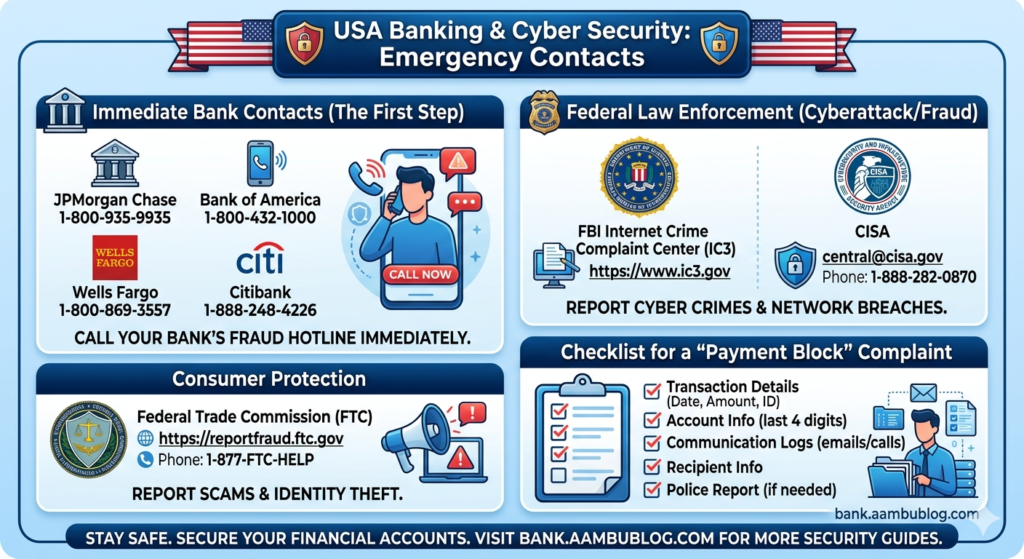

In the USA, reporting a banking security incident usually involves three levels: your Bank, Federal Law Enforcement, and Consumer Protection Agencies.
1. Immediate Bank Contacts (The First Step)
If a payment is blocked or money has been stolen, the user must contact their specific bank’s fraud department immediately.
| Bank Name | Fraud / Emergency Phone |
|---|---|
| JPMorgan Chase | 1-800-935-9935 |
| Bank of America | 1-800-432-1000 |
| Wells Fargo | 1-800-869-3557 |
| Citibank | 1-888-248-4226 |
| U.S. Bank | 1-877-595-6256 (Fraud Liaison Center) |
2. Federal Cyber Security & Law Enforcement
If the “block” or fraud is due to a cyberattack (hacking, phishing, or malware), these are the official government channels for complaints:
- FBI Internet Crime Complaint Center (IC3)
- Website: https://www.ic3.gov
- Purpose: This is the primary site for filing a legal complaint for any “cyber-enabled” crime or financial fraud.
- CISA (Cybersecurity & Infrastructure Security Agency)
- Email: central@cisa.gov
- Phone: 1-888-282-0870
- Purpose: For reporting large-scale technical banking breaches or critical infrastructure threats.
- Federal Trade Commission (FTC)
- Website: https://reportfraud.ftc.gov
- Phone: 1-877-FTC-HELP (1-877-382-4357)
- Purpose: For reporting scams, identity theft, and bad business practices.
3. Detailed Checklist for a “Payment Block” Complaint
When filing a complaint for a blocked payment or fraud on your blog, advise readers to have this “Evidence File” ready:
- Transaction Details: Date, exact amount in USD, and the Transaction ID.
- Account Info: The last 4 digits of the account/card involved (never the full number).
- Communication Logs: Copies of any phishing emails, fake texts (smishing), or records of the phone call (vishing).
- Recipient Info: Any information about where the money was supposed to go (the scammer’s bank name or crypto wallet address).
- Police Report: If the loss is significant, a report from the local police station is often required for insurance or bank reimbursement.
4. Why is a payment “Blocked”? (Analysis)
On bank.aambublog.com, you can explain that a block usually happens for three reasons:
- Security Trigger: The bank’s AI detected an unusual location or a high-risk recipient.
- OFAC Compliance: The USA government blocks payments to certain countries or individuals on “Sanctions Lists.”
- Suspected Fraud: If the transaction looks like a “push payment” scam, the bank may freeze it to protect the user.