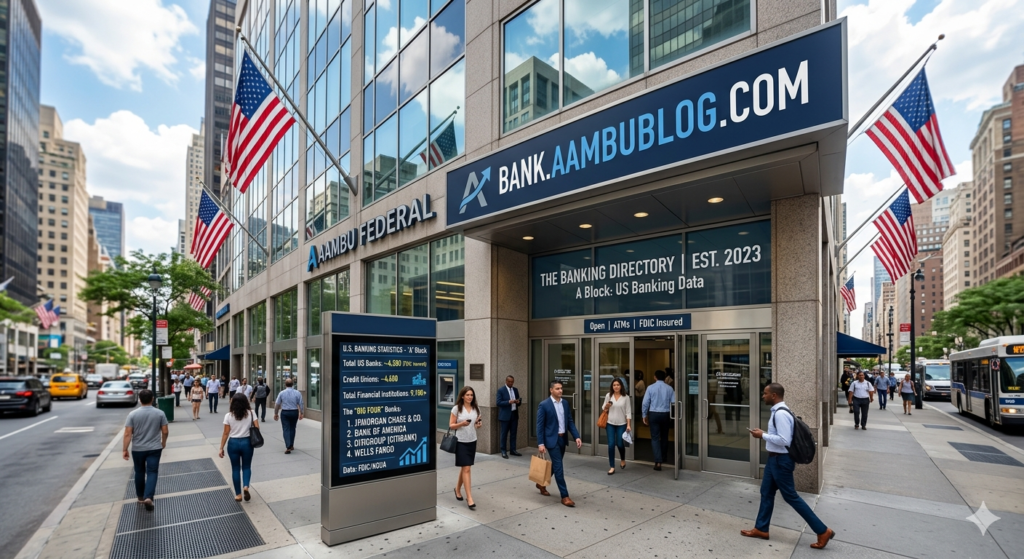
Commercial banks in the United States play a vital role in providing liquidity, loans, and secure savings options. While there are thousands of banks across the country, a few “megabanks” dominate the landscape in terms of assets and reach.
What is a Commercial Bank?
A commercial bank is a financial institution that accepts deposits, offers checking account services, makes various loans, and offers basic financial products like certificates of deposit (CDs) and savings accounts to individuals and small businesses.
The Top 10 Commercial Banks in the USA (By Assets)
If you are looking for the most stable and widely accessible banks, these are the top players as of 2026:
| Rank | Bank Name | Headquarters | Primary Strength |
|---|---|---|---|
| 1 | JPMorgan Chase & Co. | New York, NY | Largest overall; best technology app. |
| 2 | Bank of America | Charlotte, NC | Excellent rewards and physical branch reach. |
| 3 | Citigroup (Citibank) | New York, NY | Strong international presence and credit cards. |
| 4 | Wells Fargo | San Francisco, CA | Leading mortgage and small business lender. |
| 5 | U.S. Bancorp (U.S. Bank) | Minneapolis, MN | High-rated customer service in the Midwest/West. |
| 6 | PNC Financial Services | Pittsburgh, PA | Known for “Virtual Wallet” innovative accounts. |
| 7 | Truist Financial | Charlotte, NC | Large regional presence in the Southeast. |
| 8 | Goldman Sachs (Marcus) | New York, NY | Leading in high-yield online savings. |
| 9 | Capital One | McLean, VA | Best for no-fee accounts and top-tier credit cards. |
| 10 | TD Bank | Cherry Hill, NJ | “ |
1. Accessibility
Do you need a physical branch to deposit cash, or are you comfortable with a 100% digital experience? Banks like Chase and Bank of America have the most ATMs, while Capital One is great for digital-first users.
2. Fees and Minimums
Many large commercial banks charge a monthly maintenance fee unless you keep a minimum balance. Always check if the bank offers “No-Fee” checking or if they waive fees for students and seniors.
3. Interest Rates (APY)
Commercial banks typically offer lower interest rates on savings compared to online-only banks. However, banks like Marcus by Goldman Sachs or Capital One often provide more competitive rates.
4. Digital Tools
In 2026, a bank is only as good as its app. Look for features like Zelle integration, mobile check deposit, and robust security alerts.
The Number of Commercial Banks in the USA (2026 Update)One of the most frequent questions in American finance is: “Exactly how many banks are there?” While it feels like there is a bank on every corner, the actual number of individual banking companies has been shrinking for decades due to consolidation.Current Statistics (Q1 2026)According to recent data from the Federal Deposit Insurance Corporation (FDIC) and the Federal Reserve:Total FDIC-Insured Institutions: There are approximately 4,313 insured institutions (as of March 2026). Commercial Banks: Of those, roughly 3,880 are classified strictly as commercial banks.Savings Institutions: The remaining ~430 are savings and loan associations.Historical Context: The Shrinking NumberTo put these 2026 numbers in perspective, look at how the industry has consolidated over time:
| Year | Approximate Number of Commercial Banks |
|---|---|
| 1984 | 14,483 |
| 2008 | 7,061 |
| 2020 | 4,375 |
| 2024 | 3,912 |
| 2026 (Current) | 3,880 |
Why Are the Numbers Decreasing?
Even though the number of banks is going down, the banking industry’s total assets reached a record high of over $25 trillion in March 2026. This is happening for three main reasons:
- Mergers & Acquisitions: Larger banks (like Chase or PNC) often buy smaller community banks to expand their reach.
- Regulation Costs: Smaller banks sometimes find it too expensive to keep up with complex modern banking regulations.
- Digital Banking: Technology allows one bank to serve millions of people nationwide without needing a massive physical presence in every single town.
Physical Branches vs. Institutions
It is important to distinguish between a “Bank” (the company) and a “Branch” (the building). While there are only about 3,880 commercial banks, there are still over 78,000 physical bank branches across the United States.