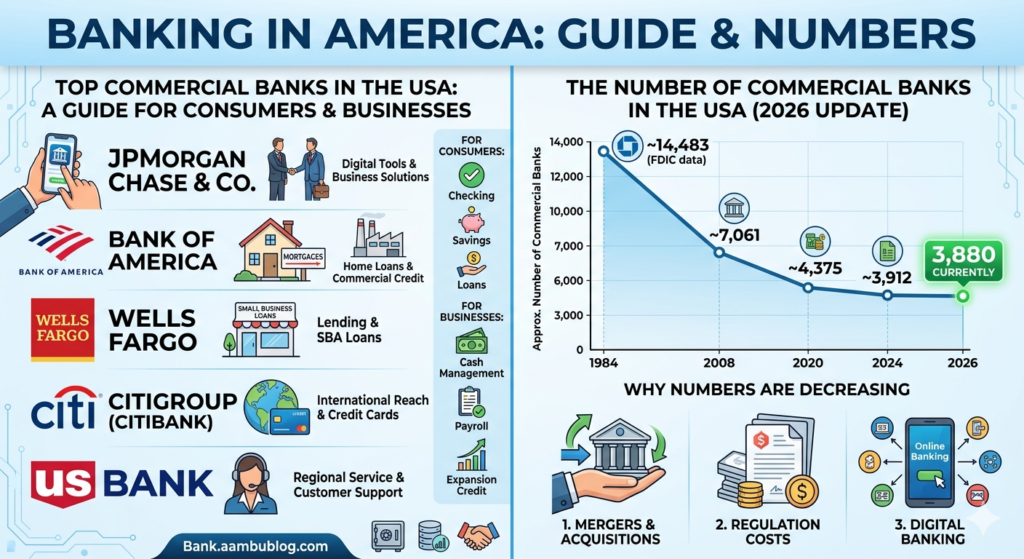
The banking landscape in the USA is quite vast, consisting of a few massive global players and thousands of smaller community banks. According to the latest data from the Federal Deposit Insurance Corporation (FDIC):
Current Statistics
- Commercial Banks: There are approximately 4,580 FDIC-insured commercial banks currently operating.
- Credit Unions: If you include credit unions (which function similarly to banks), there are about 4,600 additional institutions.
- Total Financial Institutions: Combined, there are over 9,100 deposit-taking institutions in the country.
The “Big Four” Banks
While there are thousands of banks, the following four institutions hold nearly 40% of all customer deposits in the U.S.:
- JPMorgan Chase & Co. (Largest by assets)
- Bank of America
- Citigroup (Citibank)
- Wells Fargo
Key Trends
- Consolidation: The total number of banks has been decreasing for decades due to mergers and acquisitions (larger banks buying smaller ones).
- Physical Presence: Despite the rise of digital banking, there are still over 70,000 physical bank branches across the 50 states.
- Community Banking: A unique feature of the U.S. system is the high number of “Community Banks” that serve specific local towns or counties rather than the whole country.